Ep 044: Diablo IV
Two Rocks. One Hell. Zero Complaints.
By the time Alex and Luke sat down to record this episode of Low Five Gaming, Diablo IV had just landed on Game Pass, Season 9 had gone live, and Blizzard's three-year-old action RPG was suddenly everywhere again — a game that had never really left, now flooded with a fresh wave of players experiencing it for the first time. The timing was, for once, almost too convenient. What neither host could have fully anticipated was how completely the game would work on them — two self-described Diablo newcomers with more miles on a couch than in a dungeon, playing one of the most deliberately engineered dopamine engines in modern gaming. The question going in wasn't whether Diablo IV was good. The question was whether it was the kind of good that holds up to scrutiny, or the kind that only reveals itself after you've already lost four hours to it and stopped caring about the difference.
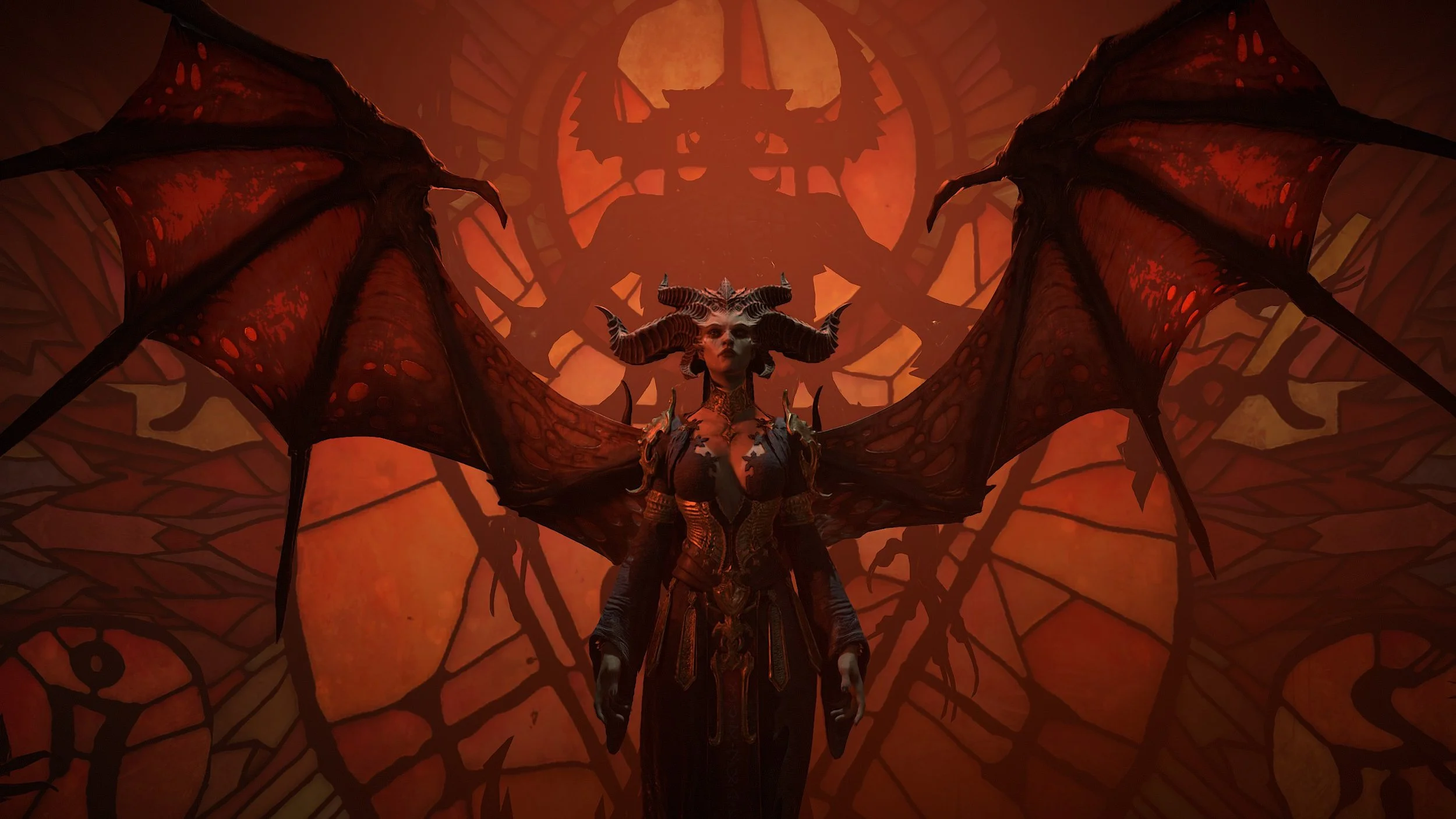
Somewhere between skeleton number one thousand and skeleton number one thousand and one, it clicks. The loot noise, the number bump, the cooldown timers all firing in rhythm — Diablo IV is not a complicated game at its core. It is a game about standing in the middle of a demon horde and watching the stimuli go brrrr, and it does that better than almost anything else out there. That it also contains multitudes — a vast open world, a deeply layered skill tree, a live-service seasonal structure, and some genuinely spectacular set pieces — is what makes it worth sitting down to discuss at all.
Diablo IV was developed and published by Blizzard Entertainment, announced at BlizzCon 2019 and released on June 5th, 2023. It carries a Metacritic score of 86, with a main story runtime of roughly 26 hours per HowLongToBeat — though that number stretches considerably the moment a side dungeon catches your eye. Alex played on both PC and Steam Deck and completed the main questline. Luke stuck to PC and remains somewhere in the middle of Sanctuary, having taken the scenic route in the most literal sense. They recorded this episode as Season 9 had just launched, which also happened to coincide with the game landing on Game Pass and PlayStation's subscription service — meaning they were surrounded by an influx of freshly-minted noobs exactly like themselves.
Neither host has meaningful Diablo history. Luke had never played any entry in the series. Alex has a vivid childhood memory of Diablo 1 — playing it in a co-worker's dark basement on a PC setup with the full shelf-and-CD-case situation, close to thirty years ago — but never got far in that one, and only put a couple of hours into Diablo 3 on Switch. This is, by their own admission, babies' first Diablo. The perspective is acknowledged and leaned into: if you have a general curiosity about the franchise but don't know a paragon board from a pit run, this is the episode for you. What they found is that the game meets you exactly where you are. The core loop — move through Sanctuary, clear enemies, collect gear, assign abilities, repeat — is immediately approachable, and the depth is entirely opt-in. Luke estimates it took him twenty hours before he started actually reading item descriptions. That's not a design failure. That's a remarkably wide on-ramp.
The class selection set the tone early. Alex went Barbarian — tank, as always, as he knew he would and couldn't stop himself from doing — and later experimented with a Rogue and a Sorcerer. Luke rolled a Druid, which turned out to also be extremely tanky: shapeshifting between bear and werewolf, summoning a wolf pack that legendary gear eventually upgraded into werewolf companions, and dropping lightning storms via ultimate ability. Alex's summary of their co-op sessions was that it was like cutting butter with a katana. "We brought two rocks to a gunfight," Luke said, and he wasn't wrong, but both of them kept showing up to the gunfight anyway. The online connectivity — a sticking point for two hosts who are comically adverse to mandatory internet connections — turned out to be the game's best surprise. Linking up was two clicks. Enemy scaling adjusted to both players automatically. And beyond deliberate co-op, just running around the open world with other players populating the same towns, organically converging on events, was its own low-stakes pleasure. They're willing to forgive the lack of a pause button here in a way they were not in Elden Ring, which says something.
What holds the whole thing together is Blizzard's evident craftsmanship in the details. The opening CGI cutscene is so good that Alex looked up whether it used real actors (it doesn't). Set pieces throughout the game telegraph bosses before you reach them — glimpses of something enormous moving in the background, pieces of a snake visible in the distance — in ways that reward attention without demanding it. The voice acting is campy on purpose, and it works. Alex also flagged a four-episode animated miniseries Blizzard released on YouTube that lays out the game's lore through Lorath, your narrator-companion — a modern equivalent, he noted, of the kind of backstory that used to live in box set manuals. The one genuine gripe: Alex completed the main quest and received a black screen where the credits should have been. Apparently the addition of the DLC shifted the credits to the end of that content instead. He has not bought the DLC. He remains creditless. It bothers him more than it probably should, and he is correct to let it bother him.
Both hosts rate the game on a scale of Pentagon Tips — a nod to the game's five character classes. Luke gives it five out of five; he loves that he can text Alex, and in two clicks they're dungeon-clearing, and he can put it down and pick it back up without reintegration anxiety. Alex lands at four and a half, docking half a pentagon for the credits situation. Strong recommend for non-online gamers who are curious — and an explicit shoutout to anyone who's been sleeping on a discount waiting for one that's dirty enough to justify the jump.
Sidequestin’: Alex has been launching a short-form content series across YouTube, TikTok, and Instagram under the Low Five Gaming banner — #PocketPix (a showcase of his handheld collection, pulling carts at random from Star Wars lunchboxes), and #STRTSCRN (retro game startup screens, currently featuring N64 titles). He also played some Freedom Finger, a shmup about piloting a flying middle finger through space, after a friend's recommendation. Luke has 40-ish hours in Brotato, bought the expansion on sale, and stands by every one of those hours. He's also been playing Cardboard Town, a card-based rogue-like builder with a crunchy name he can never remember, and reports that NCAA Football is back and the sickness has returned. Both hosts have rolled new seasonal Sorceress characters: Alex named his Sabrina (the teenage witch, obviously), and Luke named his Lady Dukes, which makes him laugh every single time.
This episode is unofficially brought to you in part by disc golf. Alex played 30 holes at Blue Ribbon Pines, first time out this season, with a rotator cuff that had opinions about holes 22 through 30.
Diablo IV is available on PC via Battle.net and Steam, PlayStation, and Xbox — and currently on both Game Pass and PlayStation's subscription service. Find the full episode wherever you pod, and come argue about your build in the Discord.
APPLE PODCASTS // AUDIBLE // GOOGLE PODCASTS // POCKET CASTS // PODBEAN // PODCAST ADDICT // SPOTIFY // STITCHER
AND EVERYWHERE YOU LISTEN TO PODCASTS!
Low Five Gaming is a Studio Low Five Production.
More Low Five Gaming Episodes You Might Like
If Diablo IV scratched the itch for loot-driven progression and build tinkering, these episodes explore games that hook you with systems, optimization, and the constant pull of getting stronger.
Hades — While more run-based, Hades taps into that same build experimentation loop, where each attempt is a chance to refine your setup and chase a stronger combination.
Cyberpunk 2077 — A different structure, but Cyberpunk shares Diablo IV’s focus on builds, gear, and shaping your character through layered progression systems.
The Legend of Zelda: Tears of the Kingdom — Not loot-driven in the same way, but TOTK echoes Diablo IV’s systems-first mindset, rewarding players who engage deeply with mechanics and experimentation.