Ep 046: Cult of the Lamb
The Cutest Cult You'll Ever Mismanage
Cult of the Lamb arrived in 2022 as one of those rare genre hybrids that seemed almost too clever for its own good — a roguelite and a colony sim sharing the same screen, dressed in pastel horror and published by Devolver Digital, a studio that has built a reputation on exactly this kind of mainline-weird. Three years and several free updates later, it's still the kind of game that tends to generate strong opinions on either side of a very specific threshold. On Low Five Gaming, Alex and Luke both crossed that threshold — and didn't entirely agree on what was waiting on the other side.
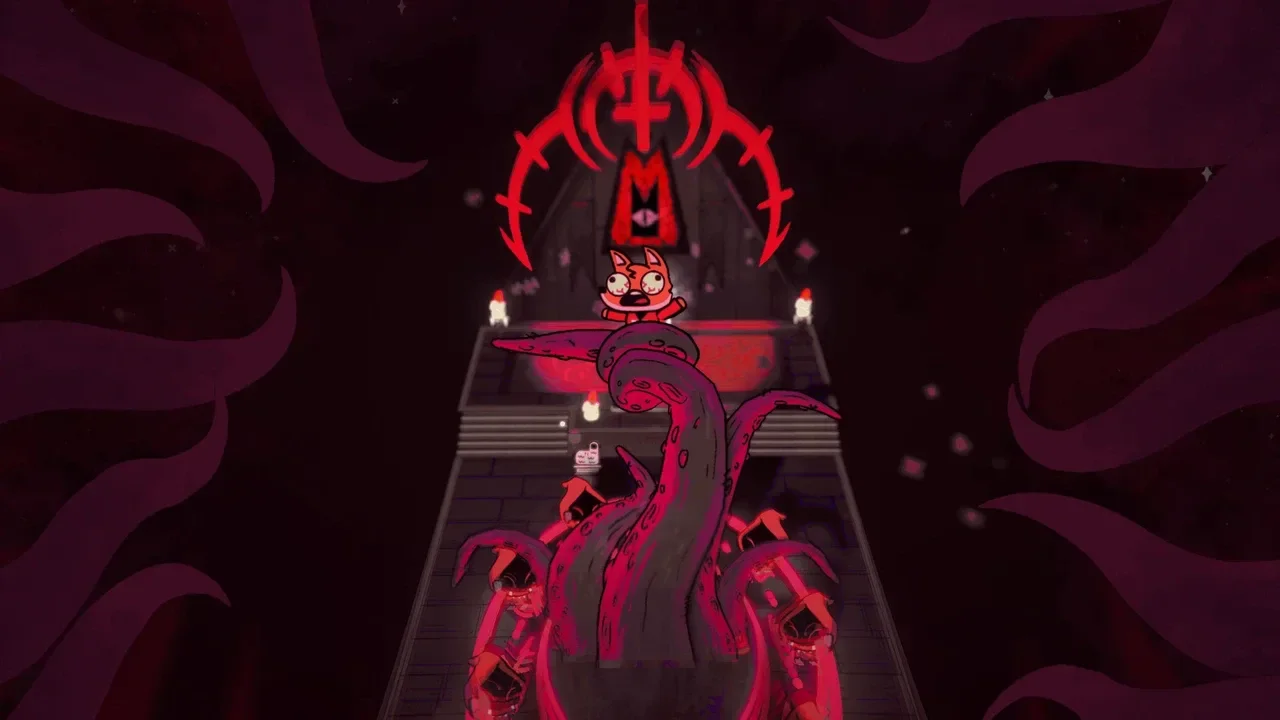
The pitch for Cult of the Lamb is almost too good: you're a lamb, the last of your kind, resurrected by a mysterious chained deity called The One Who Waits, and tasked with building a devoted cult in his name. You crusade through twisted lands to defeat the four bishops who hunted you down. You come home, feed your followers, perform rituals, clean up an absolutely unreasonable amount of poop. It's adorable. It's dark. The juxtaposition is the whole point, and it lands.
Developed by Massive Monster and published by Devolver Digital, Cult of the Lamb dropped August 11, 2022. It holds an 82 on Metacritic (PC), runs 15 to 20 hours for a standard playthrough, and has been continuously expanded with free post-launch updates — including co-op, added in 2024. Alex picked it up as a Christmas gift for Luke, which Luke acknowledges made it somewhat a voluntold pick for the episode. Both played primarily on their Steam Decks (Alex dipped into PC for a spell). Neither rolled credits. Both have opinions.
The game runs two loops in parallel. The crusades take you into procedurally generated dungeons — four regions, each ruled by a bishop — where you fight through rooms, collect resources, rescue followers, and gather tarot cards as power-ups. The map structure at each decision point draws comparisons to Slay the Spire: a branching path where you choose between crop rewards to bring back to the base, follower pickups, or weapon upgrades for the current run. The combat is good to very good — the roll dodge feels tight, enemy variety is solid across the different regions, and there's enough weapon and ability layering to keep runs interesting. The path to each bishop runs through four mini-boss apostles first, and the bosses themselves have genuine personality.
Back at the base, you're running a cult. Followers need food, sleep, and faith. You build farms, sleeping quarters, outhouses, and ritual spaces. You perform sermons at your shrine to generate faith for upgrades, conduct rituals — sacrifices, weddings, resurrections, funerals — and manage a doctrine skill tree that shapes your cult's direction. The big question the game keeps asking is what kind of leader you want to be. You can lean into the darkness: sacrifice dissenters, build fight pits, feed your followers worse and worse things, eventually explore cannibalism as a resource management strategy. Or you can be Luke, who unlocked an upgrade making his followers believe in the afterlife so when their friends die naturally they actually gain faith instead of losing it. Alex meanwhile was quietly sacrificing anyone who looked at him sideways.
The poop system is its own thing. Followers produce waste, waste needs scooping, the shovel has an upgrade path, and somehow maxing out the poop shovel is one of the most satisfying progression moments in the game. There's also fertilizer to manage once you unlock the outhouse. The devs were clearly having fun.
Luke's early read — "master of none" — softened significantly after pushing past the 10-hour mark and letting the two loops find their rhythm. The game is designed so neither side demands your full attention at once: you come back from a crusade, there's some cleanup to do, some decisions to make, and then you head back out. It doesn't overwhelm the way a dedicated management sim might, and it doesn't punish a break the way a pure roguelite would. It's a grip it and rip it game — you can pick it up a week later and not feel lost. Alex's main friction throughout was the clock. The day counter kept ticking whether he was in the base or out on a crusade, and the min-maxer instinct to optimize every hour gave him a low-grade Majora's Mask anxiety he couldn't fully shake.
Both hosts came in at 3 out of 5 — three poop scoops from the outhouse, three points on a pentagram, however you want to measure it. It's good, closer to very good than great. It never became the obsession it could have been, but it never became a chore either. Against pure roguelites like Hades it falls short; against pure management sims like Animal Crossing it falls short. As a game that blends both genres into something genuinely novel, at $25 at launch, it more than earns its place.
Recommended for Devolver fans and anyone who likes either genre — not an ideal entry point for new gamers, a little too complex and standoffish for that. Spooky season is an ideal time to pick it up.
Side Quests: Luke got Mini Motorways as a birthday gift from Ace (a puzzle game with a clean pastel aesthetic and real-world city maps — Dublin, Moscow — for the geography nerd in your life) and discovered Megabonk, which he describes as Vampire Survivors-meets-Risk of Rain 2 in a PlayStation-era 3D environment, $10, deeply addicting. Alex acquired a free HTC Vive through his neighborhood's Buy Nothing group and has been sampling VR: VR Regatta for sailing vibes, Star Wars Squadrons for TIE fighter cockpit immersion, and Super Hot, which resulted in knocking his baseball cards off a shelf mid-session. Half Life: Alyx and Colossal Cave VR are queued up. He also started Hollow Knight on the Switch ("you're gonna love this game" — confirmed), and broke out Mario Strikers for his soccer-obsessed nephew, who initially called it stupid and then couldn't put it down.
This episode is unofficially brought to you in part by “Fantasy Football. Is it a video game, dude?”
Cult of the Lamb is available on Nintendo Switch, PC, PlayStation, and Xbox. The base game is $25. Post-launch updates have been free. Full episode wherever you listen — the Discord is open and Alex always has it.
APPLE PODCASTS // AUDIBLE // GOOGLE PODCASTS // POCKET CASTS // PODBEAN // PODCAST ADDICT // SPOTIFY // STITCHER
AND EVERYWHERE YOU LISTEN TO PODCASTS!
Low Five Gaming is a Studio Low Five Production.
More Low Five Gaming Episodes You Might Like
If Cult of the Lamb clicked for its loop-driven design and indie weirdness, these episodes dig into games that balance systems, tone, and that hard-to-put-down “just one more run” energy.
Hades — Supergiant’s roguelike hit taps into the same addictive run-based loop as Cult of the Lamb, but swaps management for tight combat and narrative progression.
Hollow Knight and Silksong — While more exploration-focused, Hollow Knight shares Cult of the Lamb’s indie craftsmanship and layered progression systems built around risk, reward, and discovery.
Jusant — Like Cult of the Lamb, Jusant is built around a singular gameplay loop, using movement and environmental storytelling to create a focused, systems-driven experience.