Ep. 038: Control
Scandinavian 70s Modern Retro Sci-Fi Jedi Shooter
Control has occupied a specific corner of the gaming conversation since 2019 — the kind of game that shows up on every best-of list, moves well on sale, and produces a nearly identical reaction in everyone who plays it: genuine admiration, moderate enthusiasm, and a hard time explaining exactly what genre they just spent eleven+ hours inside. Remedy Entertainment built something genuinely strange in the Oldest House, a brutalist Manhattan skyscraper that folds its own geometry and doesn't show up on any map, and the game around it is strange in ways that resist easy categorization. Alex and Luke came to it as Low Five Gaming's latest assignment, one carrying more critical goodwill than almost anything else in the backlog. Whether that goodwill survives contact with the actual experience of playing it is a more complicated question than either host expected going in.
Three months to finish an 11-hour game. Both hosts liked it the whole time. Neither of them wanted to play it on any given night. That's not a knock on Control — it's the specific phenomenon this game seems to produce in people, and if you've spent any time in gaming forums you've probably seen some version of it. It was good enough to keep them coming back. It just wasn't good enough to make them want to.
Control is an action-adventure game developed by Remedy Entertainment — the studio behind Max Payne and Alan Wake — and released August 27th, 2019. It's available across PS4, PS5, Xbox, PC, and Switch (via cloud only). It holds a Metacritic score of 85 on PC. HowLongToBeat lists the main story at around 11.5 hours, though Alex notes that if you're doing side content you should probably budget for 20. Luke played on Steam Deck. Alex played on PC with an NVIDIA 3080, ray tracing enabled, headphones on, office door closed. He is still recovering from it.
The premise: you are Jesse Faden, arriving at the Federal Bureau of Control — a brutalist Manhattan skyscraper called the Oldest House that shifts its internal dimensions at will, can only be found when it wants to be found, and has recently been invaded by an otherworldly paranormal entity called the Hiss. The Hiss has corrupted the bureau's personnel into a kind of interdimensional zombie army. Jesse walks in to find her brother Dylan, picks up a shifting gun called the Service Weapon off the floor of the director's office, and more or less immediately becomes the new director. The lore goes considerably deeper than that — there are objects of power, there's a consciousness called Polaris, there are dense file archives and video recordings from a researcher named Dr. Darling — but Alex's description of the narrative accessibility is accurate: "30 hours into this game you're like, okay, maybe I understand what's going on, but do you really know?" Both hosts found the lore rewarding to orbit without necessarily needing to land in it.
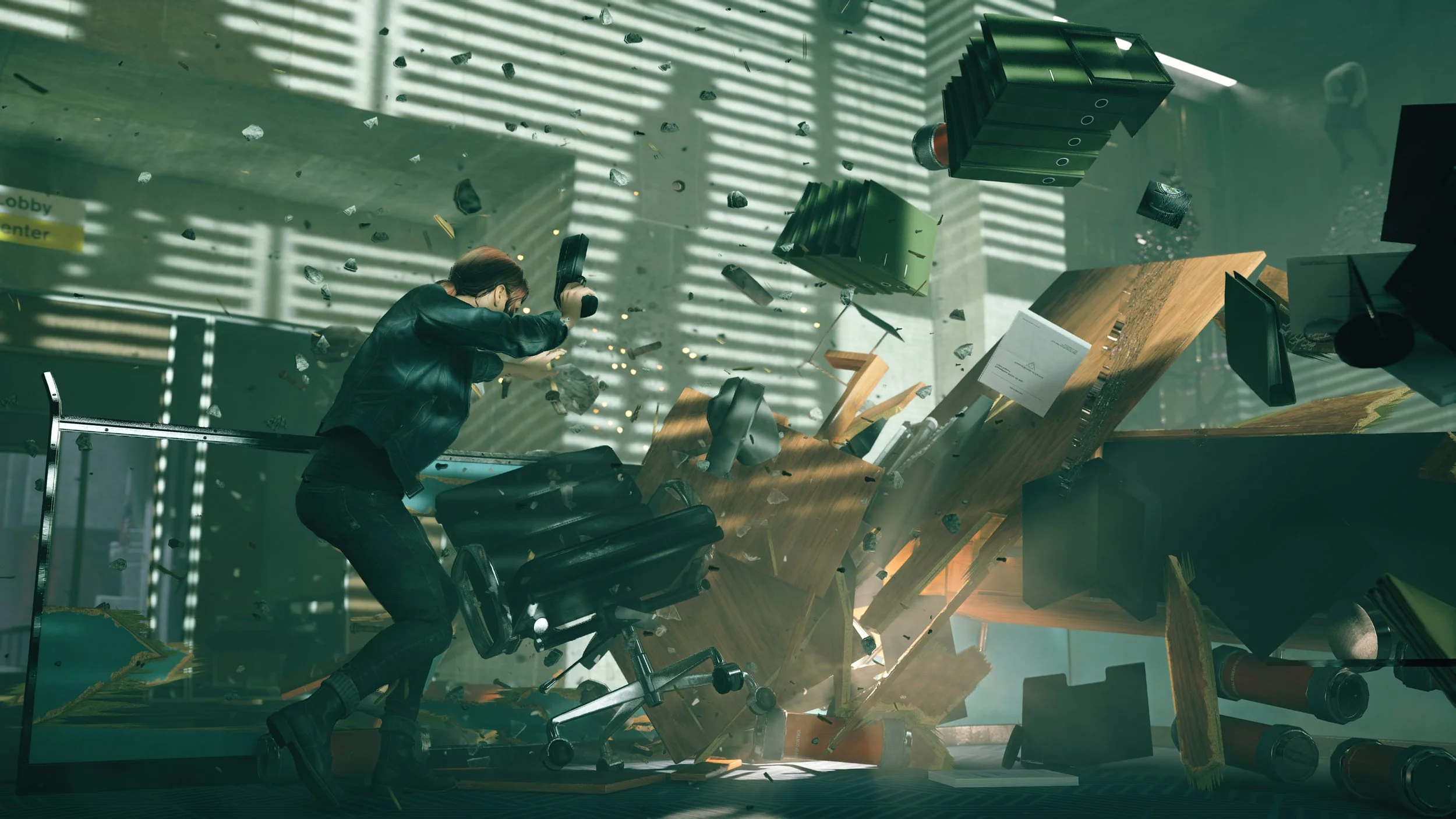
What makes Control worth discussing as a game rather than a vibe is the combat and the physics. Jesse has a Service Weapon that can be modded into four distinct forms — Grip (pistol), Shatter (shotgun), Pierce (charge sniper), and Spin (automatic) — plus paranormal abilities that she unlocks over the course of the game: a telekinetic throw, a dash, levitation, a shield she mostly didn't use, a melee she accidentally triggered instead of switching weapons, and a late-game mind-control ability that lets her take over weaker enemies and weaponize them against their own side. The throw is what both hosts maxed first and loved most. You can grab fire extinguishers, office furniture, enemy bodies, and portions of the destructible environment, and hurl them at things. This is the game. The physics engine makes it feel good in a way that most games with "destructible environments" do not, and the charge-based ammo system — no traditional ammo pickups, guns recharge on their own — means you can stay in combat chaos without pausing to hunt for bullets. Luke summarizes the intended play style as "constantly moving," which he describes as very gratifying when his composure holds, and as hiding behind walls going "oh Lord" when it doesn't.
The atmosphere is the other half of the pitch. Control is visually stunning even on aging hardware, and the brutalist architecture — concrete corridors, Soviet-modern signage, flickering fluorescent lights — creates a setting that commits fully to its tone without tipping into outright horror. It's "creepy" rather than "scary," though Luke played through the final stretch alone in a dark house with his wife out of town and spent the night checking over his shoulder. The game punctuates its world with found footage: video tapes, projector slides, and televisions playing recordings from Dr. Darling that blend live-action footage into the game's graphical environment in ways that deliberately break the frame and heighten the uncanny. Then there's the side content: a man staring fixedly at a refrigerator that has become an object of power. Puppet shows. A place called the Ashtray Maze. These are the pieces people talk about when they talk about Control, and for good reason.
The genuine tension in how both hosts experienced the game is one of the more interesting things to come out of the conversation. It's good. They both say it's good. But neither of them wanted to play it on any given night, and neither of them would have finished it without the podcast forcing the question. Alex turned on the accessibility assist mode for the final stretch — immortality and a cranked-up power bar — and has no regrets about doing so, while noting that it changes the feel of a game built around the satisfaction of learning its combat. Luke played in one-hour sessions whenever the Steam Deck battery died, and calls that the optimal delivery mechanism. The game apparently confirms something they've observed about a handful of titles: high objective quality, low subjective pull. It makes you think about it afterward. It just doesn't make you need to pick it back up tonight.
Luke gives it four to four-and-a-half psych visits out of five, with the explicit caveat to wait for a sale and go in knowing the hooks might not catch until the back half. Alex gives it three — not harsh, he clarifies, just honest about the fact that he wouldn't have finished it without external accountability and that knowing this changes how he has to rate it. Pick it up when it's cheap or free (it's been distributed via Epic and GOG at no cost in the past), play it on the hardware that does it justice if you can, and be prepared to sit with it more than rush through it.
Side Questin’: Luke has logged seven full days — 168-ish hours — in NCAA Football 25 as Coach Dukes II, now posted up as head coach of LSU with a recruiting pipeline that stretches through the Midwest. Alex spent a week sick with COVID doing Starfield runs on the Steam Deck, appreciating that the game's accessibility options don't lock out achievements (unlike Starfield's mod situation, which became a tangent). Alex has also gone deep into Marvel Unlimited, currently running concurrent Star Wars, Bounty Hunter, Doctor Aphra, and Darth Vader comic arcs across their crossover structure — picked up a year's subscription on Black Friday for around forty dollars and considers it worth every cent. Luke is working through a Star Wars graphic novel run and will be passing the first three to Alex when done.
This episode is unofficially brought to you in part by Philly cheesesteaks — specifically Luke's local neighborhood spot, cheese whiz, fried onions, and sometimes a chicken Philly with south jersey-style mayo, tomato, lettuce, vinegar, and pepperoncini. Alex is still chasing a good one. Both agree: do not order a Philly from anywhere with a spin class next door.
Control is available on PC, PS4, PS5, Xbox One, Xbox Series X/S, and Nintendo Switch (cloud). Keep an eye out — it's been available for free on Epic and GOG in the past. Find the full episode wherever you pod, and come throw furniture at enemies with us in the Discord.
APPLE PODCASTS // AUDIBLE // GOOGLE PODCASTS // POCKET CASTS // PODBEAN // PODCAST ADDICT // SPOTIFY // STITCHER
AND EVERYWHERE YOU LISTEN TO PODCASTS!
Low Five Gaming is a Studio Low Five Production.
More Low Five Gaming Episodes You Might Like
If Control stood out for its physics-driven combat and unsettling, atmosphere-first world, these episodes explore games that blend strong systems with distinct tone and identity.
Cyberpunk 2077 — Like Control, Cyberpunk pairs build-driven combat with a dense, immersive world, where systems and setting carry as much weight as the story.
Elden Ring — A different structure, but Elden Ring shares Control’s “learn the system, then thrive in it” approach, where mastery of mechanics defines the experience.
Hades — While faster and more run-based, Hades mirrors Control’s focus on fluid combat systems that reward movement, timing, and adapting on the fly.