Ep. 043: Balatro
Lizard Brain, Meet Your Dealer
Some games hook you slowly. Others go straight for the lizard brain. In this discussion from the Low Five Gaming podcast, Alex and Luke dig into Balatro — the poker-roguelike phenomenon that quietly rewires how you think about card games, strategy loops, and the dangerously satisfying pull of “one more run.”
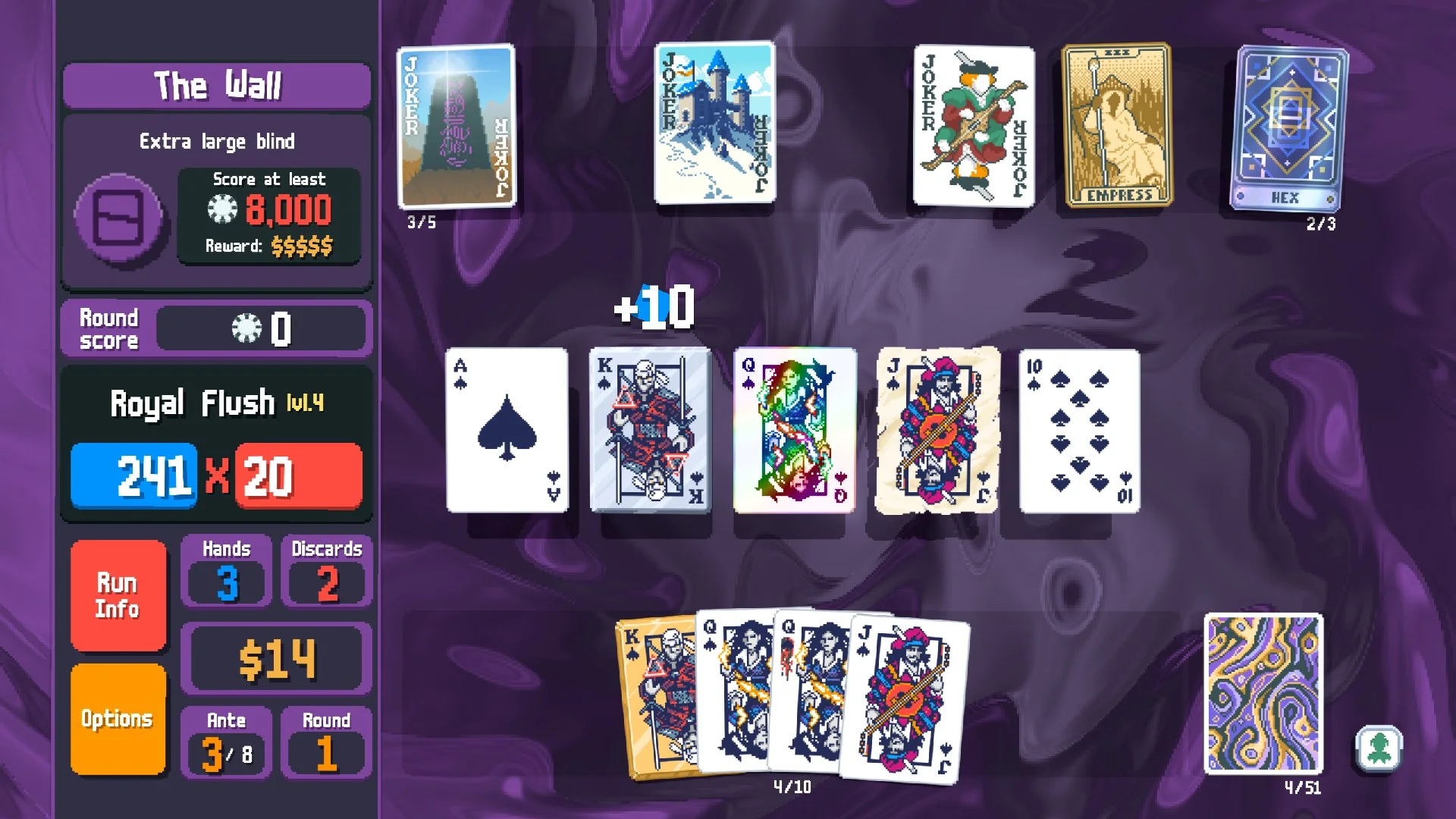
There are games you put off because you're not sure they're for you, and then there are games you put off because you know, on some level, exactly what they'll do to you. Balatro is the second kind. Both hosts had it on their radar for nearly a year. They watched it take over the conversation, sweep awards season, land on GOTY shortlists. They waited anyway — and then they stopped waiting, and three hours disappeared, and they were still in bed with the Steam Deck going "okay, one more run."
Balatro was developed solo by LocalThunk — a developer who has maintained anonymity since launch — and released on February 20th, 2024. It holds a Metacritic score of 90, and HowLongToBeat clocks a run at around 7 hours, which is a number that exists largely as a formality. Both Alex and Luke played on Steam Deck, with Luke accumulating around 30 hours and estimating he's discovered maybe 15% of the game, and Alex having beaten it exactly once. The game has since landed on mobile, won the Golden Joystick Award in 2024, and took home Best Indie, Best Debut Indie, and Best Mobile Game at The Game Awards that same year.
Describing Balatro as a "poker roguelike" is technically accurate and practically misleading. Yes, the scoring system runs on poker hands — pairs, full houses, royal flushes. But the actual point of the game is to break those hands wide open using Joker cards, Tarot cards, Planet cards, and Vouchers that compound, multiply, and warp the rules into something increasingly unrecognizable. Planet cards level up individual hand types, so a pair can be upgraded until it outscores a royal flush. Tarot cards modify the deck itself — adding lucky properties to specific cards, deleting cards that are dragging down a run, reshaping the raw materials you're working with. Jokers sit above it all, applying passive effects that stack and interact in ways that reward experimentation over anything resembling poker strategy. Luke described getting a legendary item that turned his wolf companions into werewolves — wait, wrong episode. He described getting a Joker that turned his straights into four-card straights, then stacking that with multiplier effects until the whole thing became a clean, efficient engine. Alex's breakthrough came when he finally figured out Planet cards; before that, he'd been grinding through runs with an underpowered hand setup and wondering why the points weren't coming. The game doesn't explain much. It teaches by doing, and it rewards players who are willing to learn the hard way across multiple runs.
What makes it genuinely interesting to discuss is the way it sits at the edge of what a "video game" is. Alex draws a useful distinction: Slay the Spire, a game Luke has put hundreds of hours into and still considers the better game, feels like a traditional video game with a deck-building layer. Balatro feels more like a digital card game that happens to run on a console. There are no animated boss sprites, no story, no world to explore. The bosses are just another hand, just another blind, just another set of restrictions thrown at your build to see if it holds. Luke noted this actually broadens the audience — it's the kind of thing he could plausibly hand to his wife or a non-gamer friend without them bouncing off it the way they would off a traditional roguelike. It's casino-brained in the best possible sense: the same loop that makes a slot machine dangerous is here harnessed toward actual strategy, and the moment a big multiplier chain fires and the counter lights up with a little flame — that's the whole pitch, right there.
Luke lands at four and a half Jokers; Alex gives it a full five. Luke's deduction comes partly from the crashing issue — Balatro has known instability on certain Steam Deck configurations, apparently a result of the game's notably unoptimized code, which the internet examined at length after launch. Alex had no crashes, but acknowledges the irony of a one-man operation being dunked on by coders who wouldn't have shipped anything. His only real hesitation is philosophical: Balatro is closer to Candy Crush than Inscryption in terms of what it's asking you to do with your time. That's not a knock — it's just a clarification of what you're signing up for. Both hosts strongly recommend it to anyone who has ever lost time to a game with no real endpoint and zero regrets about it.
Sidequestin’ ran long this episode. Luke has been deep in Foundation, a gridless medieval city builder he's been following since early access — he logged 70 hours before the 1.0 launch, watched his beta save get wiped the morning the final version dropped, and considers it one of the more satisfying early-access-to-launch journeys he's had with a game. He's also still in Elden Ring, cycling through approximately four new love-hate phases since last episode, and finally bought NBA 2K, which he describes as a genuinely good basketball game buried inside one of the worst menus ever assembled by human hands. Alex has been splitting time between Pokemon Emerald, the original Final Fantasy via a PSP remaster, and a significant hardware project: a RetroTink upscaler now connected to his PS2 and Dreamcast, running his retro library at full resolution on a modern TV with period-accurate CRT shader profiles. He's been playing Dark Cloud, NFL 2K, and Need for Speed Underground 2. Luke's immediate response was to request Lord of the Rings: The Two Towers next visit. Alex confirmed he has it.
This episode is unofficially brought to you in part by Slides — the footwear, not the playground equipment, though both have merit. Spring has arrived in Minnesota, the grills are out, and neither host has time to put on actual shoes.
Balatro is available on PC via Steam, Nintendo Switch, PlayStation, Xbox, and mobile. Find the full episode wherever you pod, and come compare your degenerate Joker builds in the Discord.
APPLE PODCASTS // AUDIBLE // GOOGLE PODCASTS // POCKET CASTS // PODBEAN // PODCAST ADDICT // SPOTIFY // STITCHER
AND EVERYWHERE YOU LISTEN TO PODCASTS!
Low Five Gaming is a Studio Low Five Production.
More Low Five Gaming Episodes You Might Like
Balatro thrives on that dangerous “one more run” design — the kind of game where systems stack, strategies evolve, and suddenly it’s 1:30 a.m. If that loop grabbed you, these episodes explore other games built around similarly addictive mechanics and smart indie design.
Hades — Like Balatro, Hades builds momentum through run-based progression, where each attempt feeds the next with smarter builds, evolving strategies, and that same relentless “just one more run” pull.
Cult of the Lamb — Massive Monster’s cult sim blends roguelite dungeon runs with layered systems management, scratching the same itch Balatro hits when strategy and progression start stacking in surprising ways.
Hollow Knight & Silksong — Team Cherry’s indie classic isn’t a deckbuilder, but it shares Balatro’s tight systems design and the kind of deeply obsessive play loop that keeps players pushing deeper run after run.
Explore more deckbuilder discussions on Low Five Gaming.