Ep. 034: Deadeus
A Three-Day Haunting, Built for a Four-Button Console
Horror is a genre that has never needed a big budget to work — the best of it runs on implication, negative space, and the specific unease of something that refuses to fully show itself. What it doesn't usually run on is a Game Boy cartridge from a solo developer who released his game on itch.io for whatever you feel like paying. Alex and Luke have covered a lot of ground on Low Five Gaming, but Deadeus sits in a category of one: a homebrew title from the fringes of a niche collector scene that turned out to be genuinely harder to shake than either host anticipated.
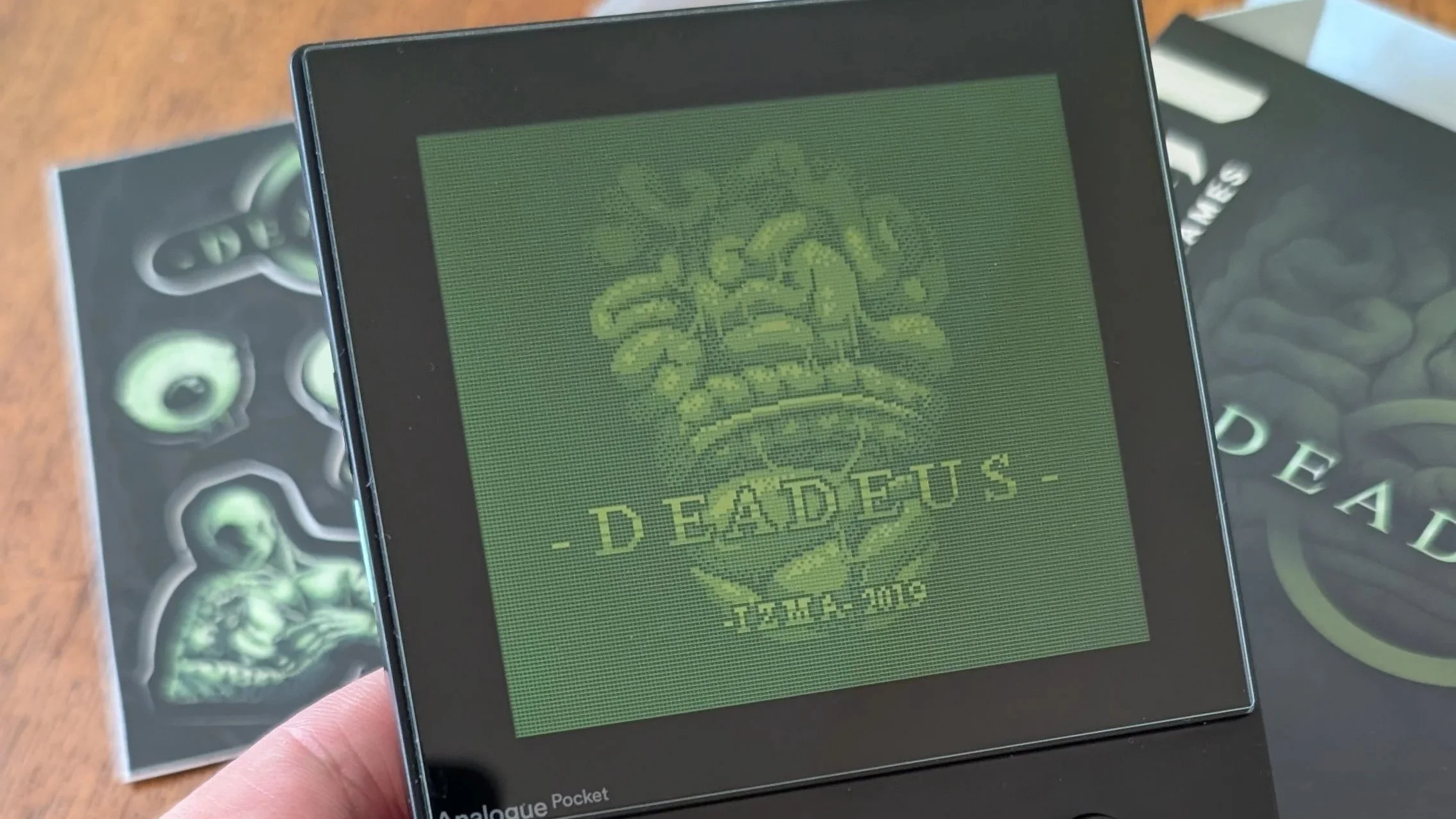
Horror is a genre that rewards constraint. The less you show, the more the imagination fills in. The more it relies on what's left unsaid, the more unsettling the experience. It's also, as it turns out, a genre that maps surprisingly well onto Game Boy hardware — a platform with a four-shade palette, no speakers to speak of, and a screen barely bigger than a playing card. Deadeus figured this out, and the result is one of the more genuinely affecting horror experiences either host has encountered in the indie space.
Deadeus was developed by Adam Birch, known under the artist name -IZMA-, and released on itch.io on August 24th, 2019 — the result of a game jam that gave it its bones, and then additional development that gave it its legs. A physical cartridge release followed in 2021. Alex played on his Analogue Pocket with the physical cart. Luke played via ROM on his Steam Deck, which is the practical way in and works fine. The game features a soundtrack by Stuart Busby. There is no Metacritic score for this one; it exists outside the review infrastructure of commercial releases, in the niche Game Boy homebrew community that Alex has been quietly building his collection around.
The setup: a young boy has a prophetic nightmare that everyone in his village will die in three days. The player navigates him through that village — talking to neighbors, poking at the environment, pulling at threads — trying to understand what's coming and whether anything can be done about it. The three-day cycle structures everything, though endings can arrive well before the deadline depending on what you do or don't do. There are eleven of them in total, ranging from abrupt and bleak to the genuinely wild "become Deadeus" route that Alex describes as his true ending — a sequence where, having gathered the necessary items and sacrificed himself into the pit, he finds the entity at the bottom of the mythology stroking a cat that the game had you dig up several hours earlier. The cat's original owner is extremely unhappy about the whole situation. Luke's true ending involved different logistics and a decision he maintains he's comfortable with, though the sequence he was aiming for did require all the items he didn't quite have. He called it a day.
What Alex keeps returning to is how well IZMA deploys the horror genre's relationship with imagination. The adults in the village act normal in a way that reads as deeply wrong. They say just enough to suggest they're carrying something they won't name. The pixel art — built on the GB Studio engine, top-down and Pokémon-adjacent in its visual language — commits to the Game Boy aesthetic while delivering character illustrations in specific scenes that punch above their weight class. Alex talked to Adam directly and found a developer who has a larger Deadeus mythology in his head than this game contains, who sees this as a chapter, and who wasn't designing a Majora's Mask tribute even if the three-day structure draws that comparison out of people. It's its own thing, operating in its own register.
The comparison that comes up most naturally in the episode is Pine Creek, the game boy horror title Low Five Gaming covered with developer Marco in an earlier episode — who, as Alex noted, cited IZMA as a direct inspiration. Pine Creek leans toward grounded, real-world dread; Deadeus leans into occult horror tropes with full commitment and a wink. Both hosts found Deadeus slightly thinner in terms of NPC density than Pine Creek, but that's a specific kind of spoiled — these are short, niche games made by solo developers for a platform that ran on two AA batteries. The comparison matters because it shows a scene developing, not because either game falls short.
Luke and Alex both land at four out of five sacrificial lambs. Luke's framing: it nails what it goes for, it's not necessarily his deepest niche, but he recognizes craft when he sees it. Alex's framing: it left him wanting more — more villagers, more branches — but frames that as a tribute to what the game does right rather than a knock on its scope. Both recommend it to horror fans, Game Boy collectors, and anyone who wants a self-contained narrative that takes about two to three hours and sticks with you afterward.
Sidequestin': This episode's side quest went thematic. Luke had been watching the Fallout TV series — slowly, several episodes in, while Ace has apparently already seen it three times — and it got both hosts talking about the current wave of video game adaptations. The prompt: two games you'd want to see as a TV show or movie, one TV show or movie that deserves a game. Luke's picks: Red Dead Redemption as a prestige HBO or Amazon series (he wants Rockstar to let someone do it right), and Metroid as a Netflix anime — atmospheric, serious, not Studio Ghibli soft. For a show that should be a game: Iron Man, which he acknowledges has been done, just never well. Alex picked Sifu — the martial arts action game with the age-progression death mechanic — as a gritty anime, and raised GTA: Vice City as a potential prestige adaptation, though he acknowledged it risked feeling derivative of Red Dead. Luke threw in Hades as an anime as a bonus, leaning into its mythology and aesthetic. The consensus show-to-game vote went to Interstellar 5555, the Daft Punk animated film, which Alex floated as a potential rhythm game direction — and which led to Luke eulogizing Hi-Fi Rush and the closure of Tango Gameworks, wondering what a Hi-Fi Rush-style game built around MF Doom might look like. Nobody had a clean answer. The Discord was invited to weigh in.
The mailbag debuted this episode, courtesy of a question from Keaton — the Masked Llama — asking both hosts about their most memorable gaming moments. Luke went to: Ratchet & Clank on Christmas morning, trusted by his mom's Target guy, playing it in anticipation through midnight mass. Civilization 5 in college, laptop cooking his lap at 3am, a single-tile choke point holding firm across an entire in-game millennium. Alex went to: the PS2 launch with Gran Turismo 3 packed in, calling the whole family over to look at the car reflections. Red Dead Redemption 2's ending, after the long haul of the full story. And Metroid Dread — the difficulty peak, the final bosses, and the specific satisfaction that comes from a game that earns its ending by making you earn it first.
This episode is unofficially brought to you in part by Naz Reid — undrafted, underestimated, Six Man of the Year, unofficial mayor of Minneapolis, and a movement built out of meme culture and genuine love that has produced beach towels, $20 tattoos, and at least one Jeopardy champion's cat. The Timberwolves. Go Wolves.
Deadeus is available on itch.io for pay-what-you-like, with a physical Game Boy cartridge release available through -IZMA-'s channels. Find the full episode wherever you pod, and come tell us what game deserves a prestige adaptation in the Discord.
APPLE PODCASTS // AUDIBLE // GOOGLE PODCASTS // POCKET CASTS // PODBEAN // PODCAST ADDICT // SPOTIFY // STITCHER
AND EVERYWHERE YOU LISTEN TO PODCASTS!
Low Five Gaming is a Studio Low Five Production.
More Low Five Gaming Episodes You Might Like
If Deadeus worked for you as a stripped-down horror experience built on limitation and imagination, these episodes explore games that use constraint, tone, and design choices to create something more unsettling than they show outright.
Pine Creek — The closest parallel, Pine Creek shares Deadeus’s Game Boy horror DNA, using minimalism and suggestion to build dread that lingers well beyond its runtime.
Control — A very different scale, but Control shares Deadeus’s commitment to atmosphere and the unknown, building tension through a world you never fully understand.
Disco Elysium — Not horror in the traditional sense, but Disco taps into a similar unease through implication and writing, letting what’s unsaid do as much work as what’s on screen.
The Legend of Zelda: Majora’s Mask — Like Deadeus, Majora’s Mask uses a repeating time structure and quiet dread to build a world that feels increasingly off the longer you sit inside it.