Ep. 035: Disco Elysium
You Are a Disaster. Revachol Needs You.
Disco Elysium has occupied a specific position in gaming conversation since 2019 — the one reserved for things that are universally praised, rarely finished, and quietly guilt-inducing in anyone who owns it and hasn't started. Alex and Luke came to it with Rick from Pixel Project Radio on speed dial as a designated guide, which suggests they knew what they were getting into. What they couldn't fully prepare for was the specific experience of spending several hours feeling lost and slightly condescended to by a video game, and then not being able to put it down.
There's a version of this game that both hosts bounced off of — confused, directionless, clicking things that seemed to lead nowhere — and then kept going because the podcast demanded it. And then somewhere in hour four or five, everything that seemed pointless started feeding back into the story, and the thing locked in, and neither of them wanted to put it down. That's the Disco Elysium experience in brief. The game does not explain itself to you. It trusts you to stay.
Disco Elysium: The Final Cut was developed and published by ZA/UM, an independent studio founded in 2016 with a team of nearly a hundred writers, artists, engineers, and producers. The game originally launched on PC in 2019, won four Game Awards, three BAFTAs, and a DICE Award, and was re-released as the Final Cut — with full voice acting across the entire script — on PC, Mac, and consoles in March 2021. It holds a Metacritic score of 97 on PC. Both hosts rolled credits: Luke on Steam Deck, Alex splitting between Steam Deck and PC. Rick from the Pixel Project Radio served as their designated "disco sherpa" — the friend you absolutely need in your corner when this game is in your backlog.
Technically, Disco Elysium is an RPG, though Alex argues the more accurate description is point-and-click adventure — a categorization Luke associates with a specific older-millennial PC gaming era, and one that undersells how deeply the genre has evolved. You play as Harry Du Bois, a detective with no memory of who he is, what he did, or why he's woken up on the floor of a trashed hotel room in the fictional city of Revachol. There's a body hanging in the courtyard. Your partner Kim Kitsuragi is waiting. You have no badge and no gun and approximately five competing inner voices all trying to tell you what kind of person you are. The game's skill system is built around four attributes — Intellect, Psyche, Physique, and Motorics — each subdivided into specific internal voices, like Logic, Rhetoric, Empathy, and Electrochemistry, that chime in throughout dialogue with additional checks, color commentary, and occasional catastrophic advice. Clothing and items modify your stats. A Thought Cabinet lets you internalize concepts you encounter in the world, spending points to unlock passive bonuses — with a brief penalty window while Harry "thinks it through." Dice rolls determine outcomes when you attempt skill challenges, with snake eyes as an automatic failure and double sixes as an automatic pass regardless of build. It's a crunchy RPG in the most literal sense, and it takes around fifteen to twenty hours before the full architecture of it becomes legible.
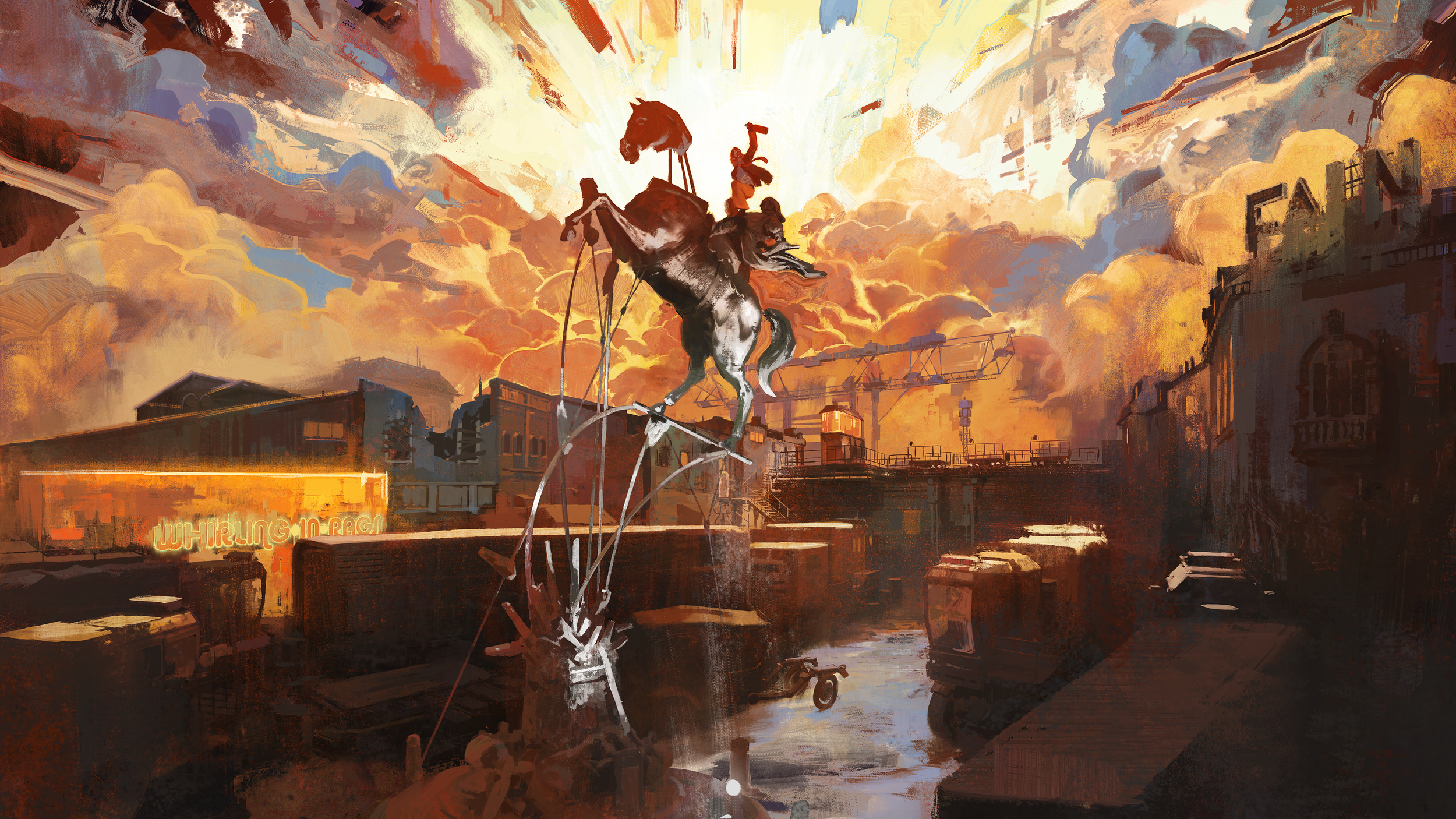
What makes it worth the steep onboarding — and both hosts are direct that there is one — is the writing. Luke calls it the best writing he's encountered in any game. Alex, finishing the night before recording, describes feeling genuinely bad about clicking through dialogue too quickly, conscious that even the scenes he was rushing contained craft he was failing to honor. The voice acting, added for the Final Cut after the original launched text-only, is exceptional throughout, with the possible exception of Kuno, a child character that Luke spent significant save-scum credits earning the right to punch in the face. The art direction is isometric and diorama-precise — Alex reaches for shoebox school projects as his comparison, the kind where a tiny world exists inside a frame. The music is strange and good. The UI on a controller is a known concession; the mouse is the correct way to play this game, and both hosts would rather you know that upfront.
The political architecture of Revachol — factions mapped loosely onto communism, capitalism, and fascism, filtered through invented country names and institutional analogies — could have made this a difficult game for two hosts who describe themselves as comfortably centrist. Instead, the game clowned both of them for it. Alex kept landing in the middle of every ideological fork; the game started generating specific centrist taunts. Luke built his character as a high-physique, low-intellect brawler and largely just didn't engage with the politics on purpose. Both of them, by accident or design, ended up playing essentially the same character. Rick had warned them they could go crazy on a first run. They went extremely reasonable. They both plan to go back.
Five empty whiskey bottles out of five. Luke calls it a full pack of smokes. Both say play it if you've ever wanted to see what a video game looks like at the top of its own genre — and wait for a sale, since it runs cheap and lands on storefronts for free with some regularity.
Sidequestin': The NBA playoffs commandeered a significant chunk of Alex's time this episode — the Timberwolves made history winning their first playoff series in twenty years, then got beat by Dallas in the Western Conference Finals. Alex has complicated feelings about the Celtics. He also watched Dune 2, attended a couch co-op session at Discord member Jimmy's place (TowerFall was the co-op highlight; Freedom Finger — a middle-finger spaceship shmup with a licensed hip-hop and indie rock soundtrack including Rhymesayers artists — the discovery of the night), and has started dabbling in Timberwolves basketball trading cards, a habit he blames directly on his renewed love for the team. Luke has been running a dad rock music book club with a friend: Neil Young, the Allman Brothers, REM, a sustained Fleetwood Mac-is-that-mom-rock debate, and a firm consensus that Red Hot Chili Peppers will be considered extreme dad rock by the time their kids are old enough to argue about it. He's also been playing Fallout 3 on Xbox after the Fallout TV show sent him to the discount bin (Fallout 3 and Fallout 4 combined for under eight dollars), and is deep into Star Wars Jedi: Survivor — which he describes as graphically stunning, occasionally glitchy, souls-adjacent in structure, and uncharted-brained in movement. He recommends starting there over Fallen Order.
This episode is unofficially brought to you in part by dad rock — defined loosely as rock your father would have listened to, not too edgy, mellow enough to accompany a Subaru commute. Father's Day is coming up. The timing is not a coincidence.
Disco Elysium: The Final Cut is available on PC, Mac, PlayStation, Xbox, and Nintendo Switch. Keep an eye out — it appears on storefronts for free with some regularity. Find the full episode wherever you pod, and come talk politics, builds, and Kim Kitsuragi in the Discord.
APPLE PODCASTS // AUDIBLE // GOOGLE PODCASTS // POCKET CASTS // PODBEAN // PODCAST ADDICT // SPOTIFY // STITCHER
AND EVERYWHERE YOU LISTEN TO PODCASTS!
Low Five Gaming is a Studio Low Five Production.
More Low Five Gaming Episodes You Might Like
If Disco Elysium clicked for its writing-first design and player-shaped storytelling, these episodes explore games where systems, choices, and structure do the narrative heavy lifting.
The Talos Principle — Like Disco, Talos uses its structure to explore big philosophical ideas, trusting players to sit with questions rather than rushing to answers.
The Legend of Zelda: Echoes of Wisdom — A different tone, but Echoes shares Disco’s commitment to player-driven solutions, building a system where how you solve problems defines your experience.
Control — Control mirrors Disco’s dense worldbuilding and commitment to atmosphere, creating a setting you orbit, interpret, and slowly piece together rather than fully decode.