Ep. 037: EA Sports College Football 25
Ten Years. One Hundred Hours. Still No Blue Blood Offer.
EA Sports College Football 25 is not the kind of game Low Five Gaming typically covers — it's a sports title from one of the largest publishers in the world, built on a licensed franchise with a decade of legal baggage and a Reddit community that treats every patch note like a peace treaty violation. It is also, somehow, one of the most requested games the Discord has ever surfaced, which tells you something about where college football sits in the lizard brain of a certain kind of adult gamer who grew up with a controller in one hand and a dormitory grievance in the other. Alex and Luke came to it from opposite ends of the investment spectrum, and the gap between their experiences turns out to be most of the episode.
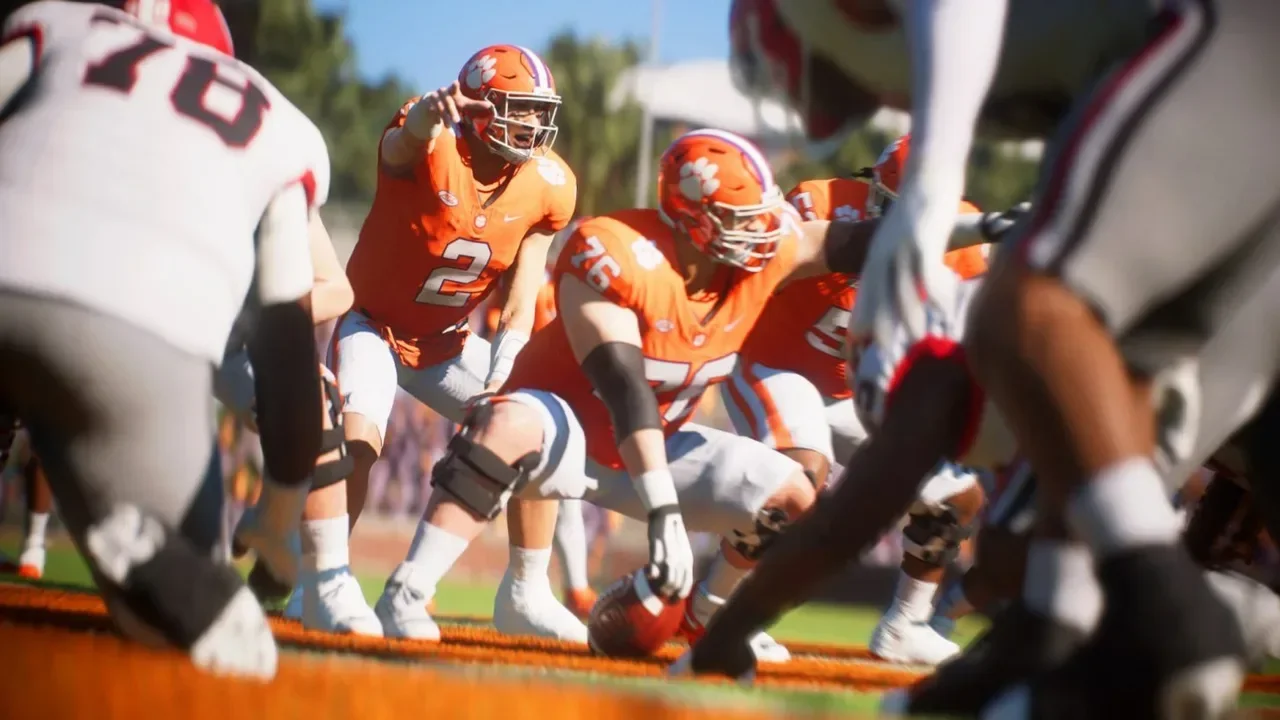
The gap was ten years. The wait was apparently worth it for most people, and Luke is most people in this scenario — he arrived at this episode with over 100 hours logged on Xbox Series X, a national championship won with the University of Akron Zips, and a current post at Iowa State that nobody respectable has bothered to poach him from yet. Alex arrived with around 15 to 20 hours, a Minnesota dynasty he's mostly been building instead of playing, and genuine questions about how RPO plays work. This is the episode where those two experiences meet midfield — the spectacle you're in the stands for.
EA Sports College Football 25 was developed and published by EA Sports and released in July 2024, ending a decade-long absence from shelves after the franchise was shelved following legal disputes over player likeness — the game used to assign numbers corresponding to real athletes' physical specs without compensating them, a practice that finally caught up with EA in court. The arrival of NIL rights in college athletics opened the door back up, and now players are named and real. The game holds a Metacritic score of 85 and a user score of 5.9, a split that tells you almost everything you need to know about its reception: critics think it's good, and the most fervent fans think it's not good enough. Luke's position is roughly that both are correct and also that the loudest people on Reddit need to go outside.
The core case for the game is easy to make. It plays differently from Madden despite sharing the Frostbite engine — different physics, different team, different feel on the field, with the explosiveness and option-heavy playcalling that made the old NCAA games distinct from their NFL counterpart. The jet sweep was briefly broken and then patched, and the Reddit community wrote what Luke describes as poems about its death. The variety in the player pool means games can turn on a single 97-speed recruit burning a too-slow defensive back, which is both realistic and absolutely broken in the best way. The dynasty mode's recruiting layer is where both hosts found themselves most engaged: building a pipeline, managing weekly recruiting hours, learning what each prospect actually cares about (winning programs, academic prestige, playing time, proximity to home), and slowly turning a mid-major into something threatening. Alex, a committed 2K guy who has never cared about the management layer of sports games, found himself more invested in how his young men were developing than in the actual football. He plays on easy for the relaxed farm simulation experience and on medium when he wants to lose.
The onboarding is a known problem, and Luke is blunt about why: all the tutorials are buried inside Ultimate Team, the card-collecting mode that wants your money. EA's incentive is for new players to go directly to the monetized mode, which means dynasty players are largely left to figure out RPOs and option reads through trial and error and text messages to Luke. The jump between difficulty settings is steep and poorly calibrated. The coaching progression system, where you create a coach and build him up through RPG-style attributes, is genuinely fun but clunky — your job market is at the mercy of an AI that apparently has no interest in offering Coach Dukes a Big Ten job regardless of how many MAC championships he wins. Auto-generated player names have produced a Jeffrey Epstein and a five-star recruit from Texas named George Bush, which are less bugs than unexpected features.
Luke gives it four years of eligibility out of five. Alex gives it three — freely acknowledging that Luke's thousand-plus hours of Madden background makes the game click for him faster, and that a softer landing pad probably yields a higher rating. Both agree: if college football and dynasty building scratch any part of your brain, it's an easy send. If you're a Madden lifer looking for a slightly different flavor, it's worth the pickup, preferably on a discount.
This episode also featured the show's first mailbag, addressing listener responses to Luke's claim that Tetris is the greatest game of all time. Responses came in from Minneapolis, Illinois, Springfield Missouri, New York, Golden Valley, and Diluth Minnesota. The Minneapolis response was suspected to be Alex testing the system. The Golden Valley response, from Michael at Bits of Time podcast, called Tetris "the peanut butter and jelly sandwich of gaming" — great, but leave it off the list. Luke called that one a draw. The scoreboard, by his count, suggested otherwise.
Sidequestin’: Luke has been playing a tiny bit of Hades 2 in early access (one friend watched; another refused on spoiler grounds) and a little Ratchet & Clank, and picked up a library book called The Samurai and the Prisoner — a mystery recommendation from the end shelf that turned out to be genuinely cool. Alex picked up Gunbrella, a Devolver Digital 2D side-scrolling platformer-shooter that is exactly his type of game. He also tried Children of the Sun, a Devolver-published puzzle shooter with a one-bullet-hits-all mechanic, and found it too repetitively gruesome for his taste — notable as the first time on the pod he's said a game simply isn't for him. He's also still slowly pushing through Control and watched a significant portion of the Paris Olympics, including most of the men's basketball, roughly half of the women's, gymnastics, and a variety of random events.
This episode is unofficially brought to you in part by pancakes — specifically, Alex's homemade flapjack recipe: one cup flour, two tablespoons sugar, quarter teaspoon salt, three-quarter cup milk, one egg, two tablespoons melted butter, one teaspoon vanilla extract, and a tablespoon of lemon juice to slightly sour the milk. Medium heat, wait for the bubbles, flip. Recipe will be in the show notes. Luke is primarily a sausage man and does not order a full pancake stack at restaurants, but will accept a single flapjack on the side to split with a toddler.
EA Sports College Football 25 is available on Xbox Series X/S and PlayStation 5. Find the full episode wherever you pod, and come build your dynasty with us in the Discord.
APPLE PODCASTS // AUDIBLE // GOOGLE PODCASTS // POCKET CASTS // PODBEAN // PODCAST ADDICT // SPOTIFY // STITCHER
AND EVERYWHERE YOU LISTEN TO PODCASTS!
Low Five Gaming is a Studio Low Five Production.
More Low Five Gaming Episodes You Might Like
If College Football 25 clicked for its dynasty-building and long-term progression systems, these episodes explore games that hook you through layered mechanics, planning, and the slow burn of building something over time. We’re being a bit liberal with our parallels — we haven’t covered additional sports games, but we play them.
Against the Storm — Like CF25’s dynasty mode, Against the Storm thrives on managing competing systems, where each run builds toward longer-term progression and smarter decision-making.
Diablo IV — A different genre, but Diablo IV shares that same compulsion loop of incremental improvement, where progression, optimization, and “one more run” thinking keep you coming back.
Hades — While more combat-focused, Hades mirrors CF25’s layered progression, where repeated attempts feed into upgrades, mastery, and a growing sense of control over the system.