Ep. 040: Kirby 64: The Crystal Shards
Short Game, Deep Pink
Kirby has never needed defending, and Low Five Gaming isn't here to provide any. Alex picked this one, a Kirby fan exercising a Kirby fan's prerogative, and Luke came in carrying a specific childhood memory of renting it from Blockbuster and sprinting to tell their mom he'd beaten it. Both hosts arrived exactly as warm as you'd expect. What neither of them fully accounted for is that a game you remember as gentle has a way of revising your memory once you're actually back inside it.
This one came to the docket via democracy, chaos, and professional wrestling. After a Discord community vote produced a three-way tie between Doom 64, Castlevania Legends, and Kirby 64, Alex resolved the deadlock by loading up WrestleMania 2000 on the N64 and setting up a three-way CPU match — Kane for Doom, Gangrel for Castlevania, X-Pac for Kirby — an idea borrowed from Dave at Tales from the Backlog's Smash Bros tiebreaker method, legally distinguished by the use of late-'90s WWF talent. X-Pac won. Kirby got the nod. Everyone wins.
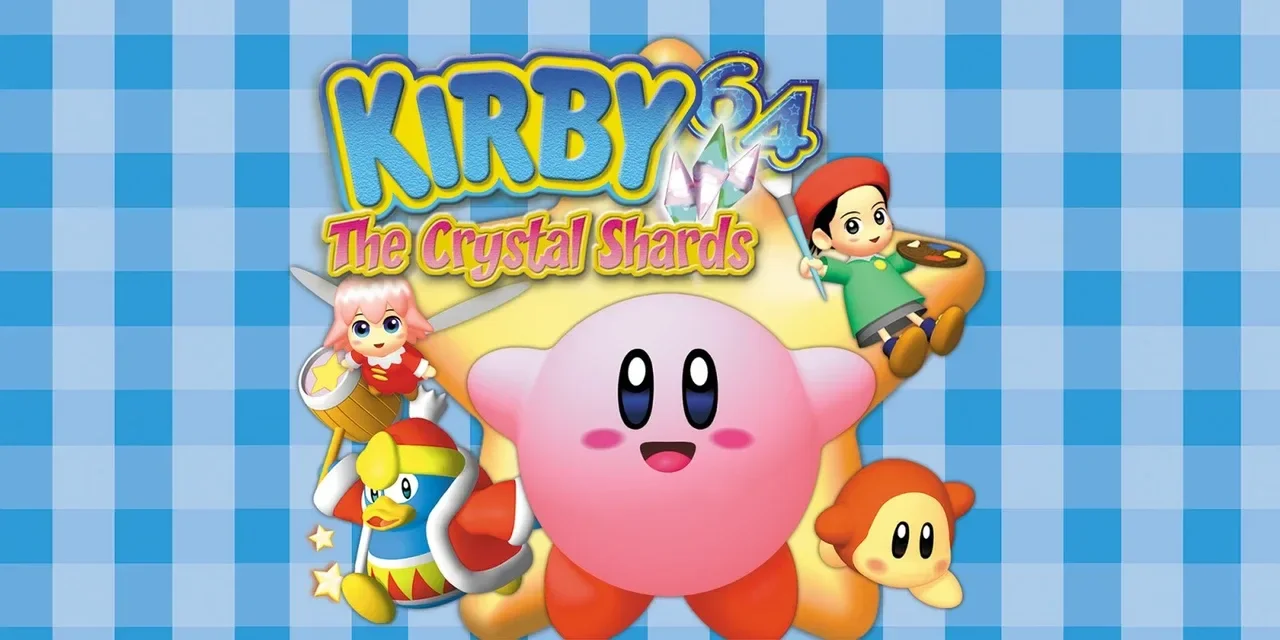
Kirby 64: The Crystal Shards was developed by HAL Laboratory and released for the Nintendo 64 in 2000. It holds a Metacritic score of 77, and HowLongToBeat clocks the main story at around four hours — which was partly the point, as Alex was juggling this with a 30-hour game he was playing for a guest appearance on another podcast. Both hosts played via Nintendo Switch Online's Expansion Pack, with Alex splitting time between the NSO version and an actual N64 with the official N64 controller, which he found significantly more natural than the pro controller for this particular game.
The premise, courtesy of the original manual rather than anything the game communicates in-play: Dark Matter has seized the planet Ripple Star and its magic crystal, a fairy named Ribbon barely escapes with the thing, it shatters across the solar system during a chase through space, and she lands on Pop Star and runs directly into Kirby. The story unfolds entirely through visuals — no dialogue, no text — which Luke describes as watching cute characters running around like something important is happening. Alex, currently deep in nightly storytime duties with his kid, read the manual aloud with genuine bedtime-story energy. The manual was the story. RIP manuals.
What distinguishes Kirby 64 from the rest of the series is its copy ability combination system. Seven base abilities — fire, ice, spark, cutter, bomb, stone, needle — can be paired in any combination, yielding up to 28 distinct power forms. Double fire produces a giant flaming snowball that plows through enemies. Double stone turns Kirby into an invincible rolling boulder. Double cutter generates a boomerang that tears through floors, walls, and anything in its path — and also, Alex notes, kills you constantly because you can't jump again until it comes back. The Darth Maul double-bladed fire-and-electric lightsaber sword is objectively the coolest and not necessarily the most effective. The bomb-spark combo just fires homing missiles out of Kirby's mouth. Luke spent a significant portion of his playthrough dying on purpose to try specific combos before figuring out what they actually did. This is acknowledged as the correct way to play.
The difficulty curve surprised both hosts. The first two or three worlds are comfortably gentle — classic Kirby, designed for children, eases you in. Then, somewhere around World 4, the training wheels come off and the boss fights start demanding actual pattern recognition. The underwater boss Acro took both hosts down multiple times. Mag Man's fire sweep move caused particular frustration. The final sections required Luke to make peace with the Switch NSO save state feature. Alex had forgotten save states were even available until well into the game, at which point he found this very funny. Neither host completed the true ending, which requires collecting all three crystal shards per stage and unlocking an additional final boss — the false ending, which both rolled, has a somewhat abrupt quality that now makes more sense in context.
Alex gives it four sucking-ins out of five. It hit the length he wanted, delivered more difficulty than expected, and the copy ability system still reads as genuinely inventive — something he kept noticing mid-playthrough, not as a historical artifact but as a mechanic that holds up. Luke lands at three out of five, maybe three and a half when nostalgia's running warm. He beat this one as a kid renting it from Blockbuster, ran to tell his mom, and she said "good job, champ" before moving on with her day. Playing it back as an adult, he briefly doubted his own childhood memory. He's decided to just let the triumph stand. Both land on it as an easy recommend for Kirby fans, a chill palate cleanser between heavier games, and a solid entry point for the children of dad gamers who aren't quite ready to hold a controller yet but enjoy watching things happen on screen.
Sidequestin’: Alex guested on Pixel Project Radio to discuss The Talos Principle, a 3D puzzler with an undercurrent of questions about consciousness and what it means to be human — one of those games where the puzzle structure and the philosophical through-line reinforce each other in ways that stuck with him. He's also been playing NBA 2K with community rosters to get an updated Timberwolves lineup and has been dipping into Railroad Tycoon 2 and Warcraft 2 on PC via GOG — less with any intention to finish them, more as nostalgic archaeology. On the live music front: Jack White played First Avenue on a deliberately small-room no-setlist tour behind his new record, masterfully conducting his band with wordless cues and switching guitars nearly every song; and Pretty Lights brought a full live electronic band setup that Alex can barely describe but wants a YouTube explainer video for. Luke has been deep in an NCAA 25 dynasty run coaching the University of Minnesota, pulling recruits from Eden Prairie and neighboring Wisconsin districts to both build his roster and sabotage the competition. He also played Maneater on Steam Deck during a dudes weekend — narrated by Chris Parnell, you are an angry shark, no notes — and is considering making the next game selection Steam Deck compatible.
This episode is unofficially brought to you in part by the Burger Press — smash the balls, sear twelve seconds, flip, two minutes, salt, pepper, cheese, brioche bun, truffle oil if you have it. Alex has made the best burger of his life. He will provide the affiliate link at some unspecified future date. Maybe. Probably not.
Kirby 64: The Crystal Shards is available on Nintendo Switch Online + Expansion Pack. Find the full episode wherever you pod, and come share your best copy ability combos in the Discord.
APPLE PODCASTS // AUDIBLE // GOOGLE PODCASTS // POCKET CASTS // PODBEAN // PODCAST ADDICT // SPOTIFY // STITCHER
AND EVERYWHERE YOU LISTEN TO PODCASTS!
Low Five Gaming is a Studio Low Five Production.
More Low Five Gaming Episodes You Might Like
If Kirby 64 landed as a deceptively simple game with surprising mechanical depth, these episodes explore games that pair charm with inventive systems and playful design.
Kirby and the Forgotten Land — A modern evolution of Kirby’s design, Forgotten Land builds on that same spirit of experimentation, translating copy abilities into a fully 3D space.
Super Mario Galaxy — Like Kirby 64, Galaxy thrives on constant mechanical variation, using one-off ideas and playful level design to keep the experience feeling fresh.
Cult of the Lamb — Beneath its cute exterior, Cult of the Lamb mirrors Kirby 64’s contrast between tone and systems, pairing a charming aesthetic with deeper mechanical layers.